AI is not a transformation. It is a revolution.
80% of AI initiatives fail for exactly the same reasons every transformation before them has failed. But the stakes are fundamentally different. Here is why AI is not the next digitalisation wave — and what separates real AI transformation from alibi transformation.
Most AI initiatives fail for exactly the same reasons every transformation before them has failed. Not because the technology does not work. Because the organisation was not ready to change — and did not build the conditions that make change possible.
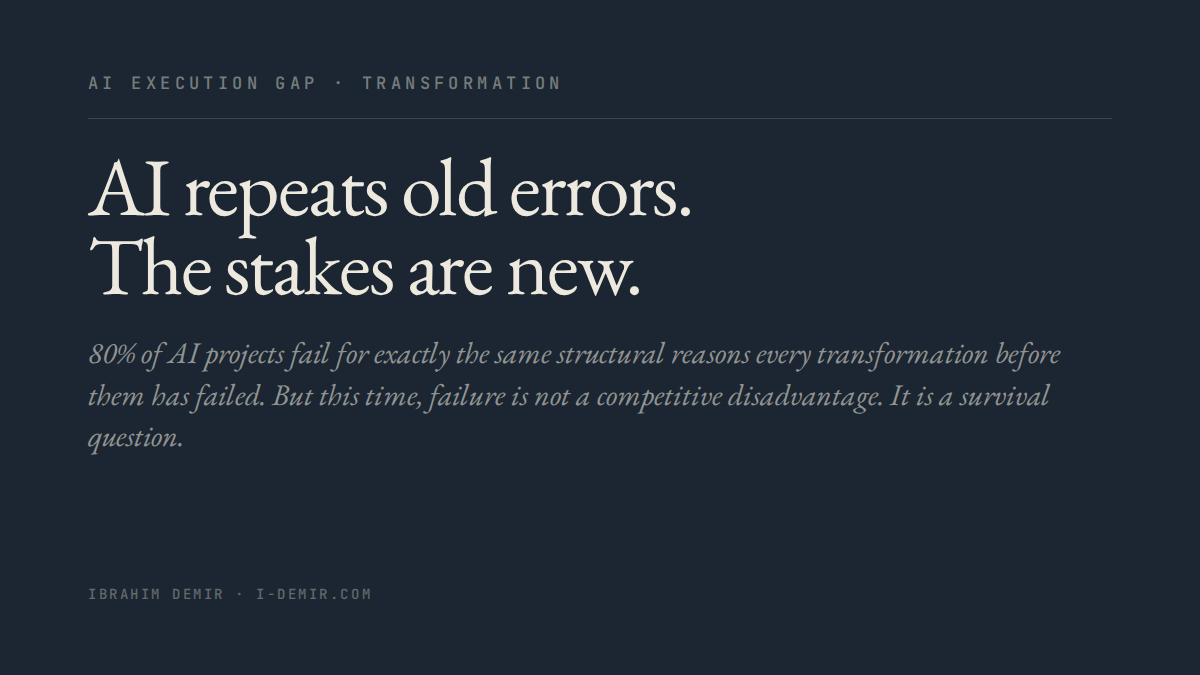
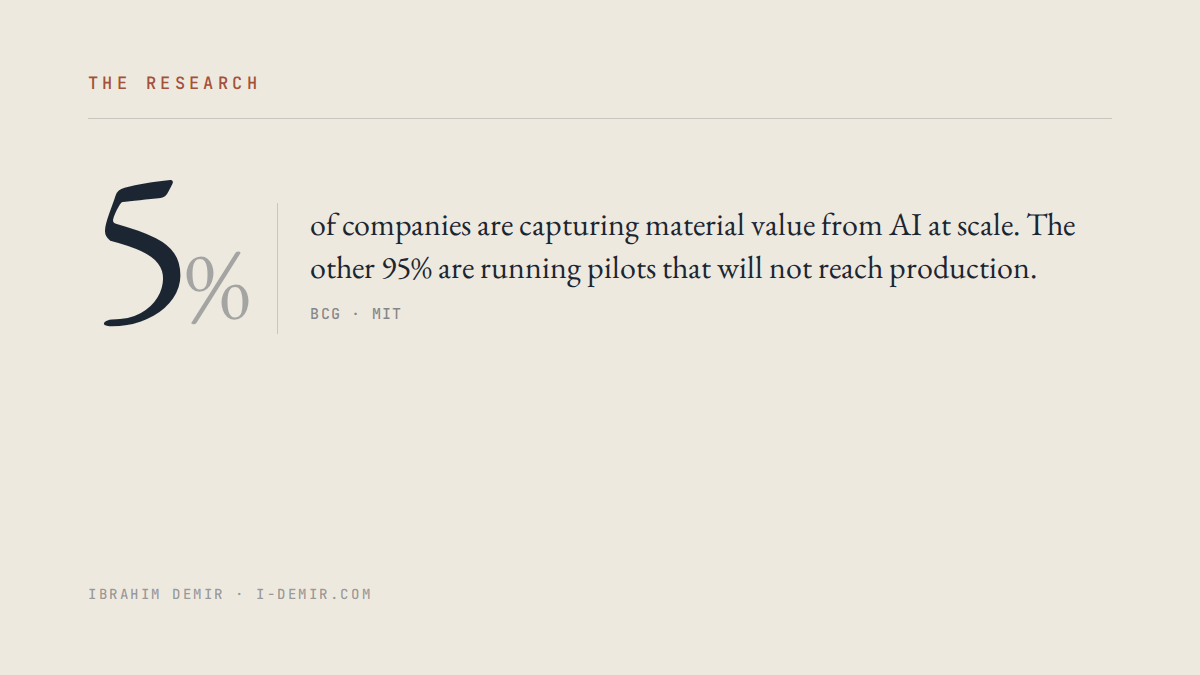
The research is unambiguous. Around 80 percent of AI projects fail to deliver intended business value. Ninety-five percent of generative AI pilots never reach production. The share of companies abandoning AI initiatives before production rose from 17 percent to 42 percent within a single year. The root causes are familiar to anyone who has run a large transformation program: weak governance, absent executive ownership, poor data foundations, shallow change management, and transformation theatre — demos that impress nobody who actually does the work.
This is not a new failure pattern. It is the same one, replayed at higher speed and higher cost.
But there is a dimension most analysis misses. AI is not the next digital transformation wave. It is becoming the operating infrastructure of every serious organisation — in the same way internet, email, and digital communication already are. Today there is no credible company that operates without internet. Within a decade there will be no credible company that operates without AI. That is not a forecast. It is already in motion.
The consequence is direct: the cost of failing at AI transformation is not a missed efficiency gain. It is strategic irrelevance. This time, the question is not whether to transform. It is whether the organisation survives the attempt.
Three things separate real AI transformation from alibi transformation.
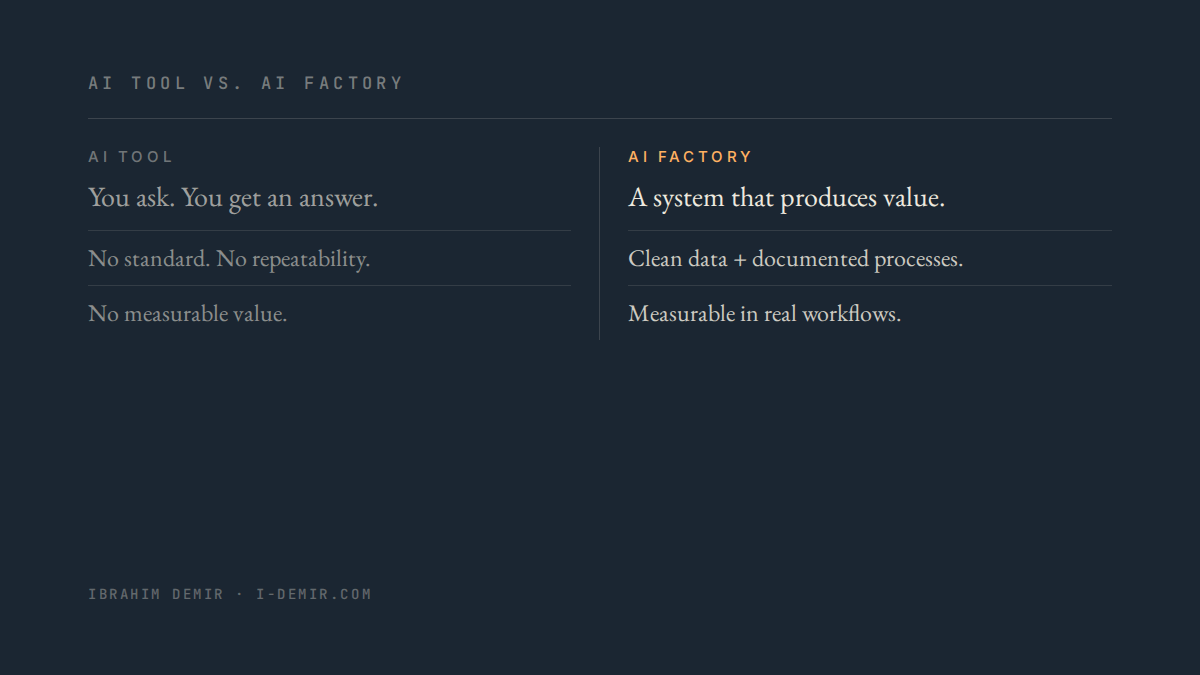
- The first is treating AI as a factory, not a tool. Giving employees access to a large language model is not transformation. It produces no enterprise standard, no repeatable output, no measurable value. Real transformation builds a system — one that generates value-oriented outputs from clean data, documented processes, and defined company knowledge. The difference between an AI tool and an AI factory is the difference between a hammer and a production line.´
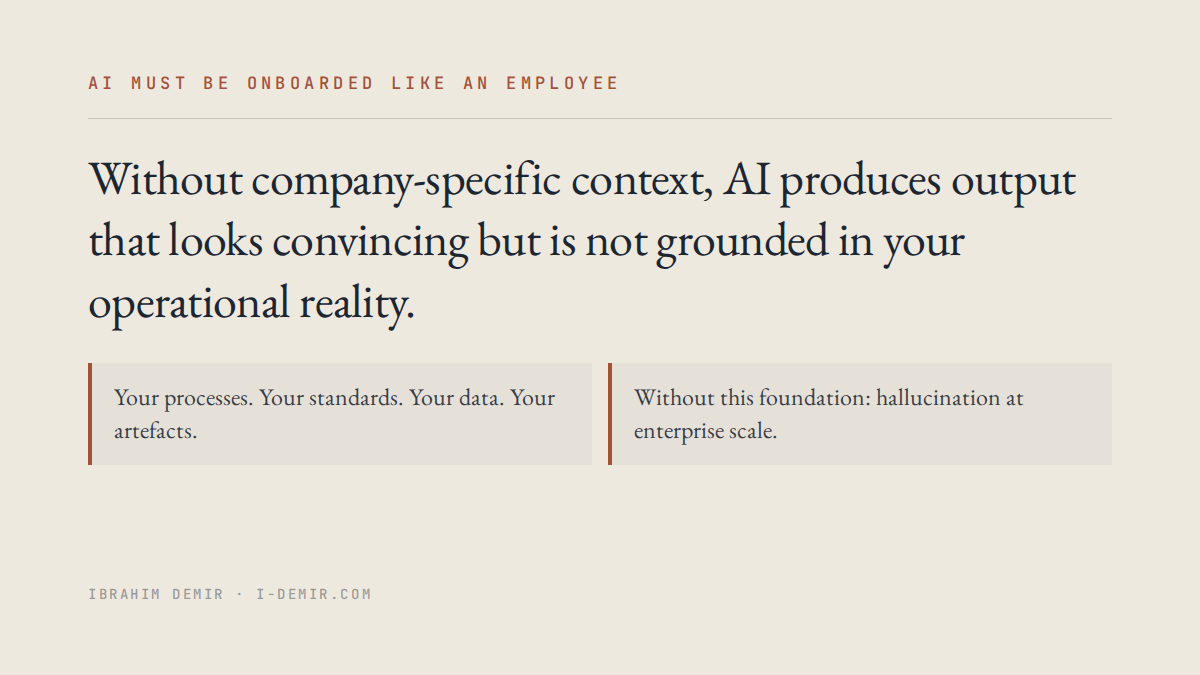
- The second is onboarding AI like a senior employee. Without company-specific context — processes, standards, data, artefacts, validated knowledge — AI produces output that looks convincing but is not grounded in operational reality. That is hallucination at enterprise scale. Real value requires giving AI the same structured onboarding a senior hire would receive: here is how we work, here are our standards, here is what we know to be true.
- The third is measuring value in real work, not in deployment metrics. A project can be on time, on budget, and completely useless. Green dashboards do not indicate transformation. The only question that matters is whether work measurably happens faster, at higher quality, or at lower cost — in real workflows, used by real people, producing real outputs.
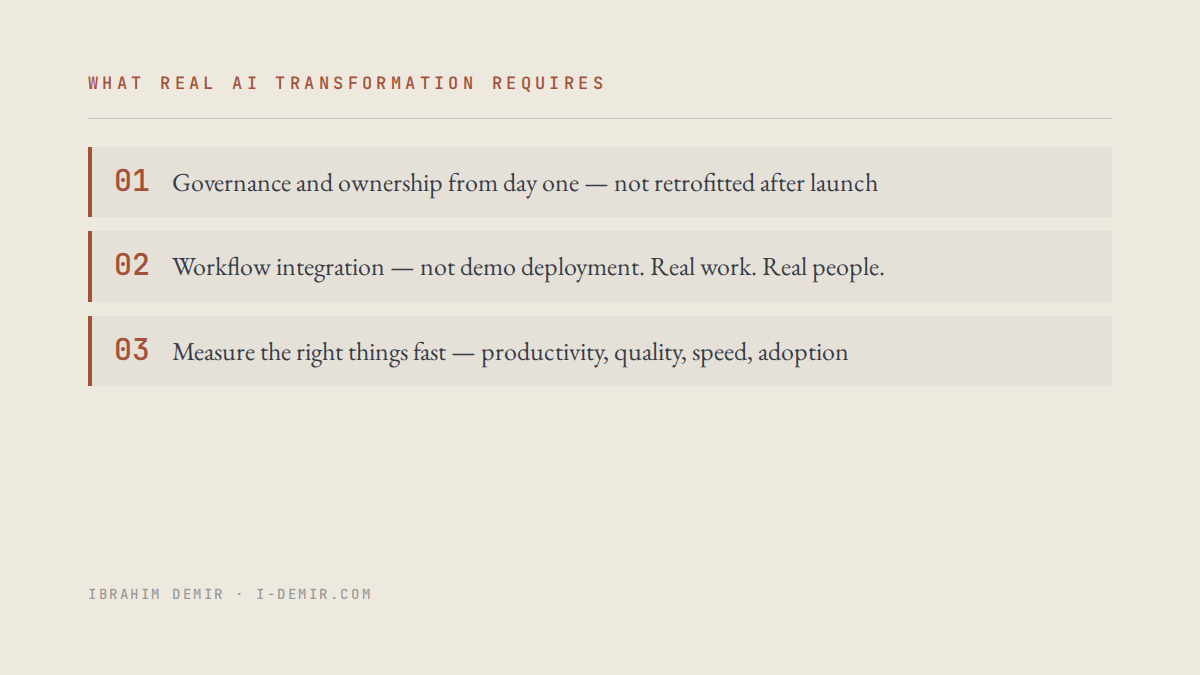
AI transformation fails for the same structural reasons every transformation before it has failed. The organisations that succeed are not the ones with the best models or the largest AI budgets. They are the ones that treat AI as an organisational change problem — and build the governance, ownership, data foundations, and measurement discipline to match.
The stakes are simply no longer the same as they were for prior waves.
This time, failing to transform is a survival question.
References
- RAND / S&P Global / Pertama Partners — AI Project Failure Rate 2026
pertamapartners.com/insights/ai-project-failure-statistics-2026 - MIT — Why 95% of AI Projects Fail
sranalytics.io/blog/why-95-of-ai-projects-fail - Gartner — Why 60% of AI Projects Will Fail
inceptds.com/blog-posts/why-gartner-predicts-60-of-ai-projects-will-fail - BCG — Only 5% of Organisations Capturing Value from AI at Scale
bcg.com/capabilities/artificial-intelligence - McKinsey — The State of AI in 2025
mckinsey.com/capabilities/quantumblack/our-insights/the-state-of-ai