Governance - Built for auditors. Not for delivery.
Governance frameworks are written, signed off, and filed. Most are never opened again — until something goes wrong and someone needs to prove due diligence. Here is why that happens, and what governance that actually works looks like.
Most governance frameworks in large transformation programs are not built to make the program succeed. They are built to demonstrate that the organisation tried. The primary audience is not the delivery team. It is the auditor, the regulator, or the post-mortem review board.
This is not incompetence. It is design.
The governance document is produced at the start, signed off, filed — and never opened again until something goes wrong and someone needs to prove due diligence. The steering committee meets on schedule. The RAG dashboard is updated. The RAID log is maintained. On paper, the program is governed. In practice, the governance structure and the delivery reality have almost nothing to do with each other.
The research confirms the scale of the problem. McKinsey finds that nearly 80 percent of major public-sector transformations fall short of their objectives — despite having formal governance structures in place. PMI data shows that organisations with actively engaged sponsors complete 40 percent more projects successfully. Yet fewer than two-thirds of programs have an assigned executive sponsor at all. The governance chart shows a sponsor. The sponsor is carrying three other initiatives this week and attends the steering committee with fifteen minutes of preparation.

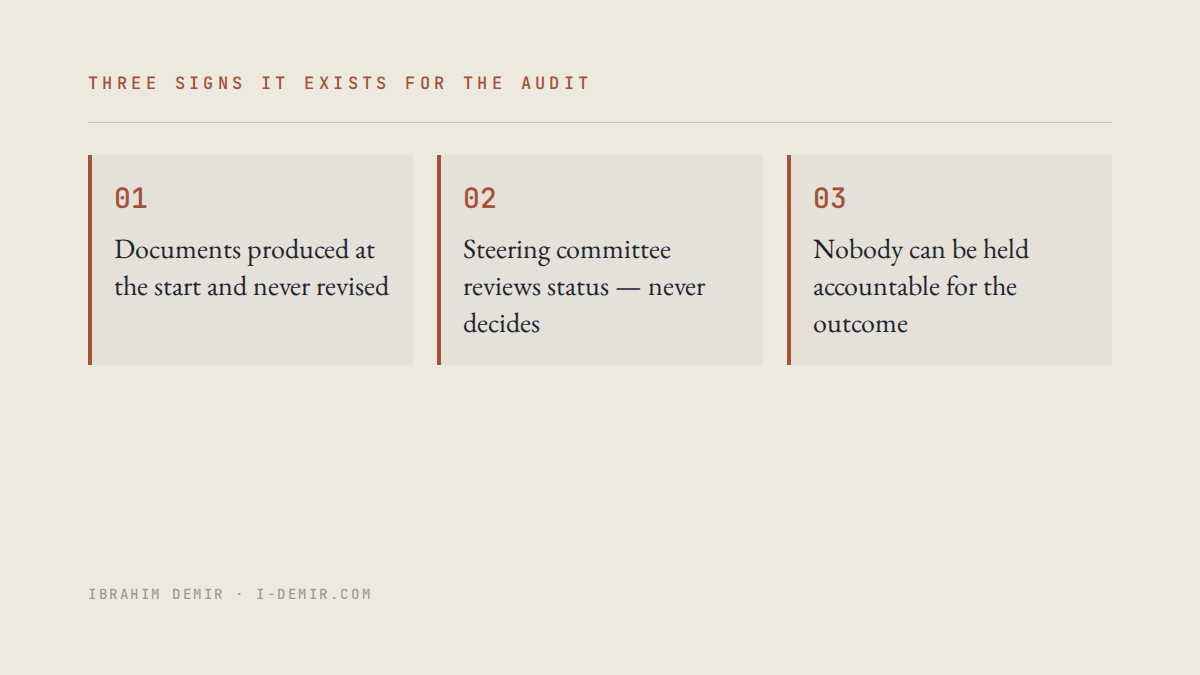
Three patterns identify a governance framework that exists for the audit rather than the program.
- The first is documents produced at the start and never revised. Governance designed for the design phase cannot make decisions during delivery. If the framework has not evolved as the program has evolved, it was never functioning as a steering instrument — it was functioning as a record of intent.
- The second is a steering committee that reviews status but never makes decisions. Reporting is not governing. If the primary output of every steering committee meeting is an updated slide deck — rather than a decision made, a priority changed, or an escalation resolved — the committee is an audience, not a governing body. It exists to receive information, not to act on it.
- The third is an absence of accountability. When the sponsor, the committee chair, and the program director can all point to someone else when delivery fails, the governance structure has produced distributed comfort rather than distributed responsibility. Governance without a named owner for every critical outcome is procedure, not governance.
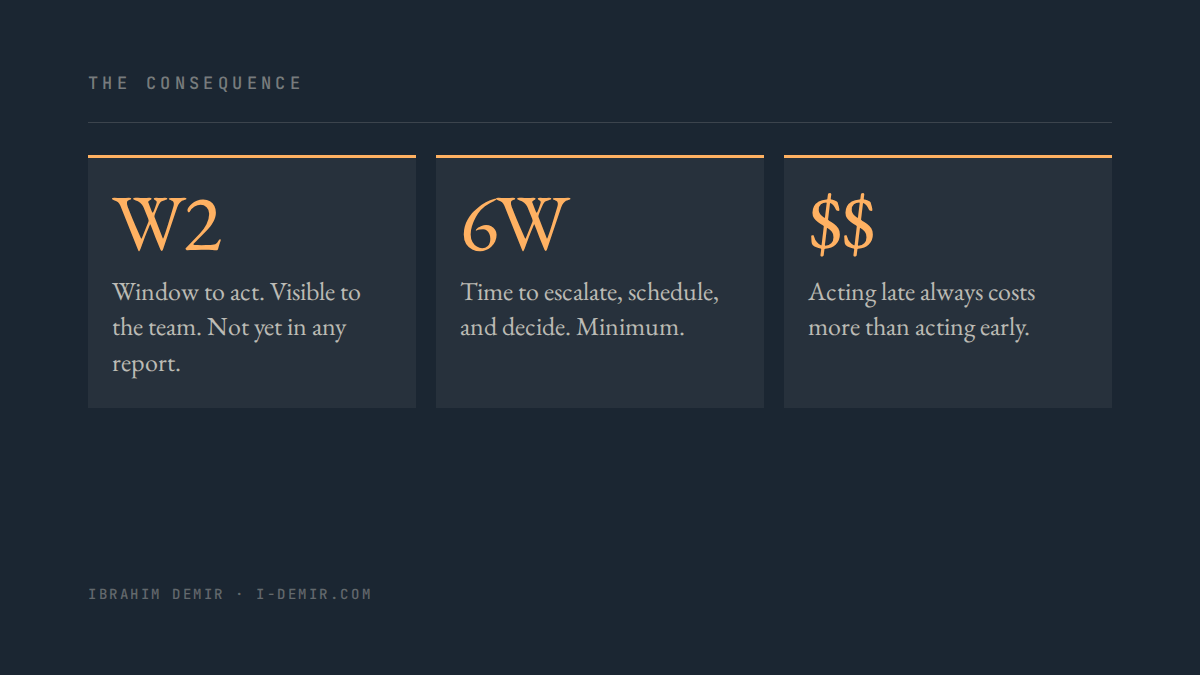
The consequence of all three patterns together is predictable. Programs drift. Risks accumulate in silence. The delivery team watches a problem grow for weeks while the governance structure remains green. By the time a formal escalation is triggered, the path leads to a committee that meets quarterly. The decision takes six weeks. The window to act closed in week two.
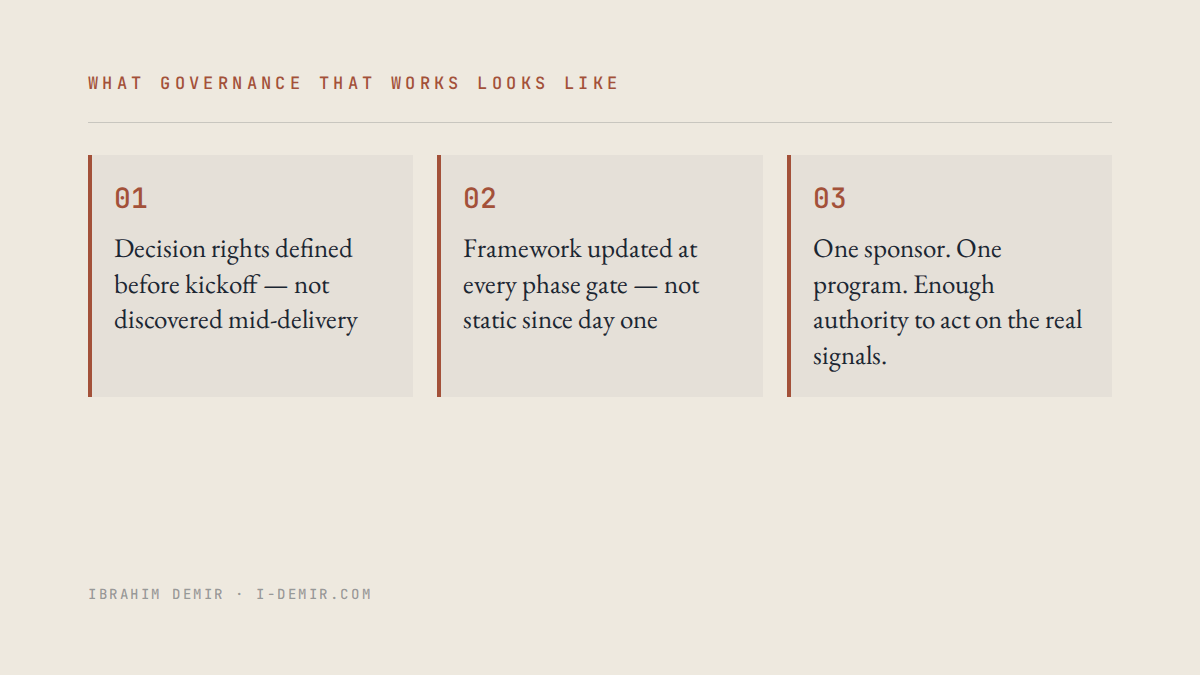
Real governance that influences delivery looks different in three specific ways. Decision rights are defined before kickoff — not discovered mid-delivery. Every major risk category has a named decision owner with a clear escalation path. Not a committee. A person, with authority to act. The governance framework is reviewed and updated at every phase gate, because the framework that worked during design cannot govern a program in cutover. And the sponsor’s role is decisions, not attendance — one sponsor, one program, with enough time to read the real signals rather than the curated slide, and enough authority to act on them.
Governance that does none of these things is not a management failure. It is a design choice — a choice to produce documentation rather than accountability, to perform oversight rather than exercise it.
Everything else is paperwork.