Moving the present — Why senior leaders who understand the strategy still cannot move the organisation
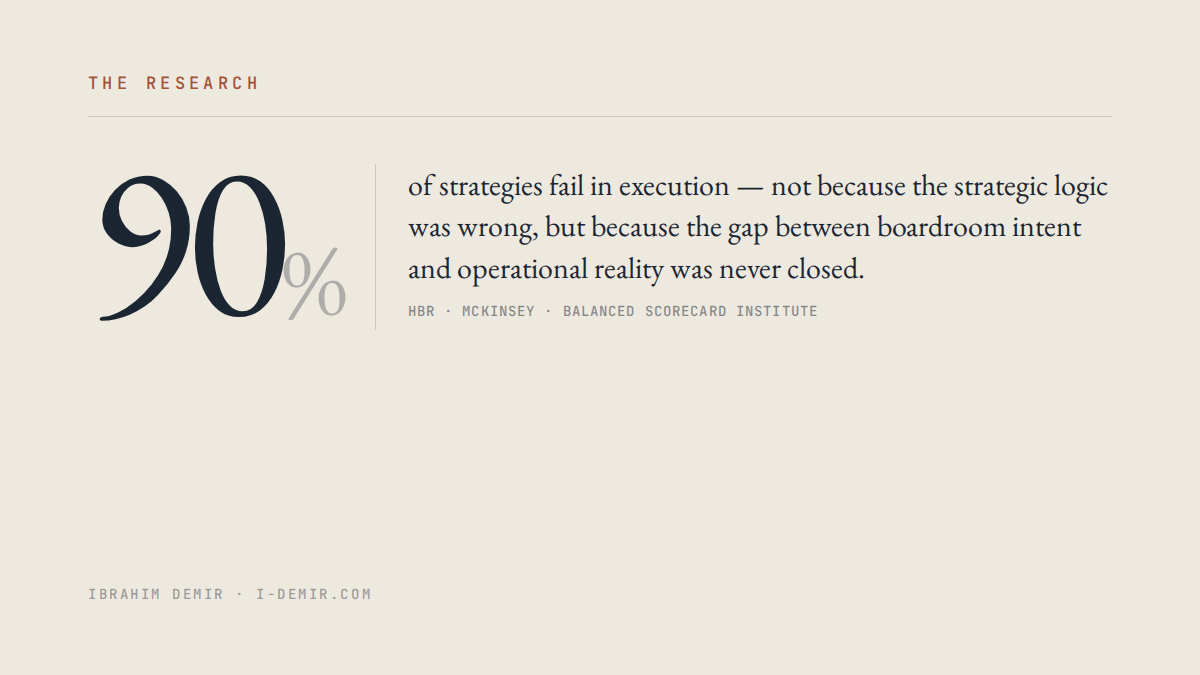
Between 60 and 90 percent of strategies fail in execution — not because the strategic logic was wrong, but because the gap between boardroom intent and operational reality was never closed. Here is why that happens, and what it actually takes to move an organisation.
Most senior leaders understand the strategy. They see the market, the competitive landscape, the trends that make change necessary. What they consistently underestimate is the distance between understanding the direction and actually moving the organisation toward it.
Research puts a number on the gap: between 60 and 90 percent of strategies fail in execution. Not because the strategic analysis was flawed. Because the translation from boardroom logic to operational behaviour was never completed. The strategy was understood at the top and absorbed — or ignored — somewhere in the middle.
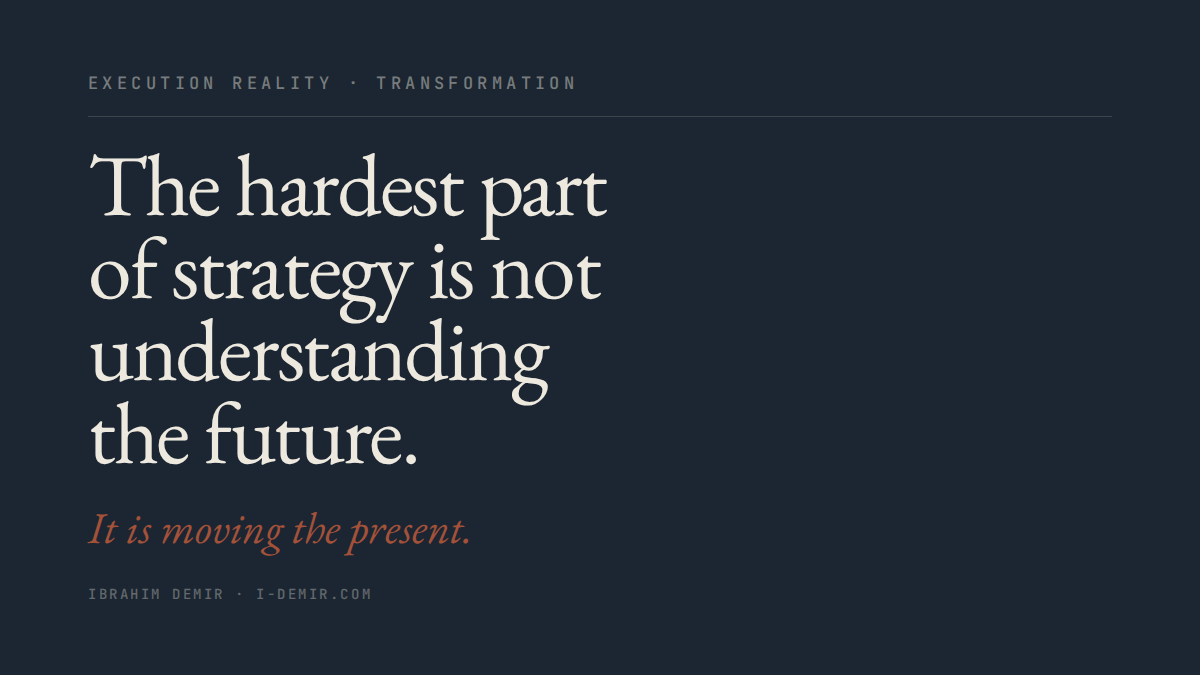
The hardest part of strategy is not understanding the future. It is moving the present.
An organisation is not an empty structure waiting to be redirected. It is built from old processes, established routines, entrenched decision-makers, informal power structures, and the accumulated weight of how things have always been done. The deeper a leader goes into execution, the more clearly this becomes visible. The devil is not in the strategy. The devil is in the organisational reality.
Three structural patterns explain why the organisation does not move despite a clear strategic direction.
The first is the assumption that strategy from the top produces movement at the bottom. Most strategies are built in offsites, validated in leadership workshops, and then handed to the organisation to execute. The operational layer — the people who actually run the processes, manage the teams, and absorb the consequences of change — are rarely involved until the strategy is already set. They inherit a plan that was not tested against their reality, and they know it. Unless operational voices are involved early enough to surface the assumptions that will not survive contact with the organisation, the strategy remains ungrounded.
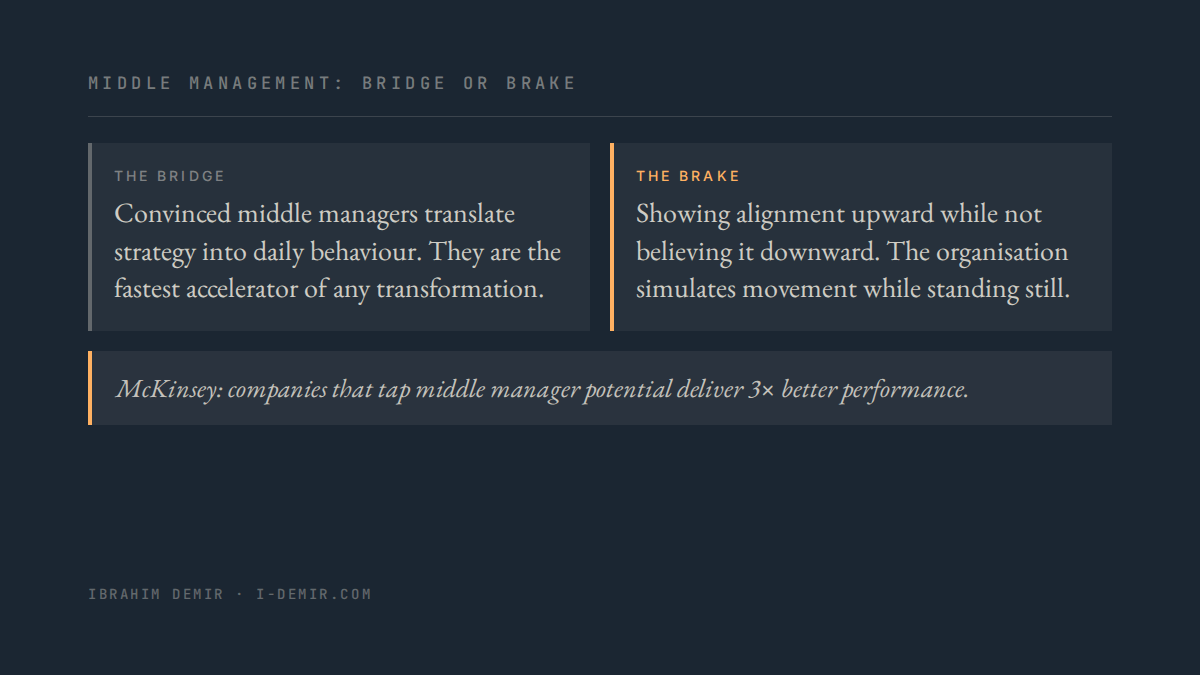
The second is the condition of the middle management layer. Middle managers are not a relay mechanism for communicating strategic decisions downward. They are the decisive bridge between strategy and real work — the only people in the organisation who simultaneously understand the strategic rationale from above and the operational constraints from below. When middle managers are convinced that the strategy is right and that they have the authority to act, they translate it into daily behaviour faster than any governance structure can. When they are not convinced, they do something more dangerous: they show alignment upward while quietly not believing it downward. McKinsey research shows that companies able to tap middle manager potential deliver roughly three times better performance. Most transformations never reach them effectively.
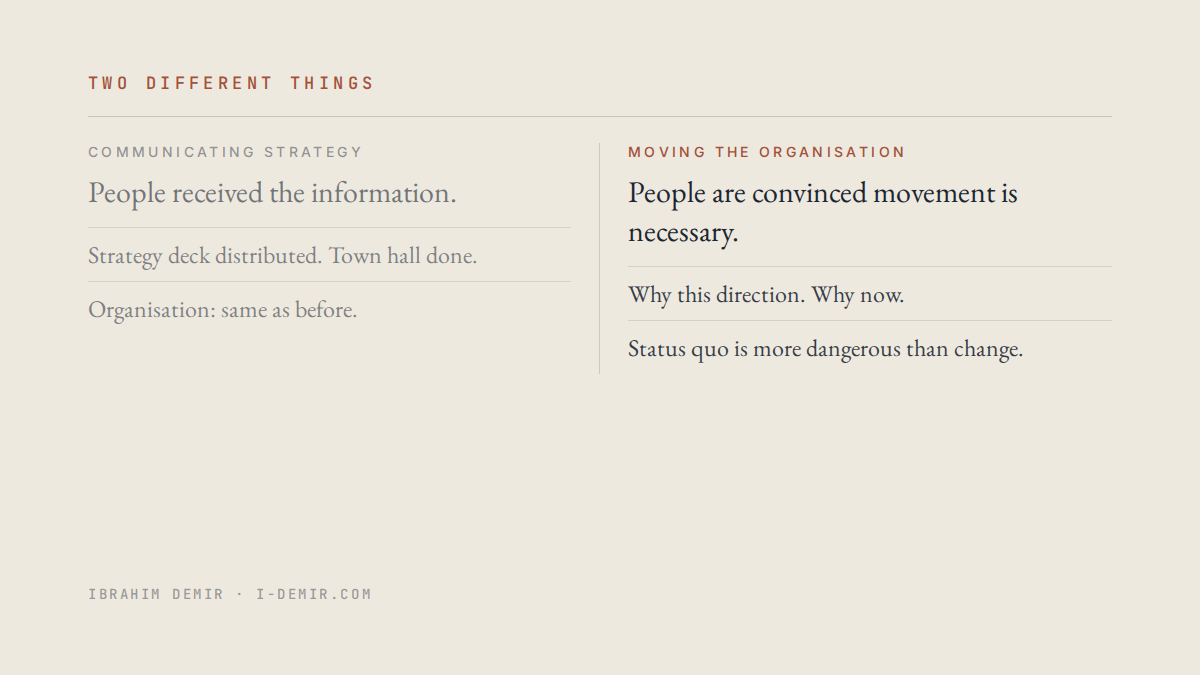
The third is the confusion between communicating strategy and moving the organisation. Communicating strategy means people received the information. Moving the organisation means people are convinced that movement is not just desirable but necessary — now, not eventually, and not as soon as conditions improve. The organisation moves when people understand why this direction is the only credible one, why the status quo carries more risk than the change, and why the leader asking for the change can be trusted with the cost of making it.
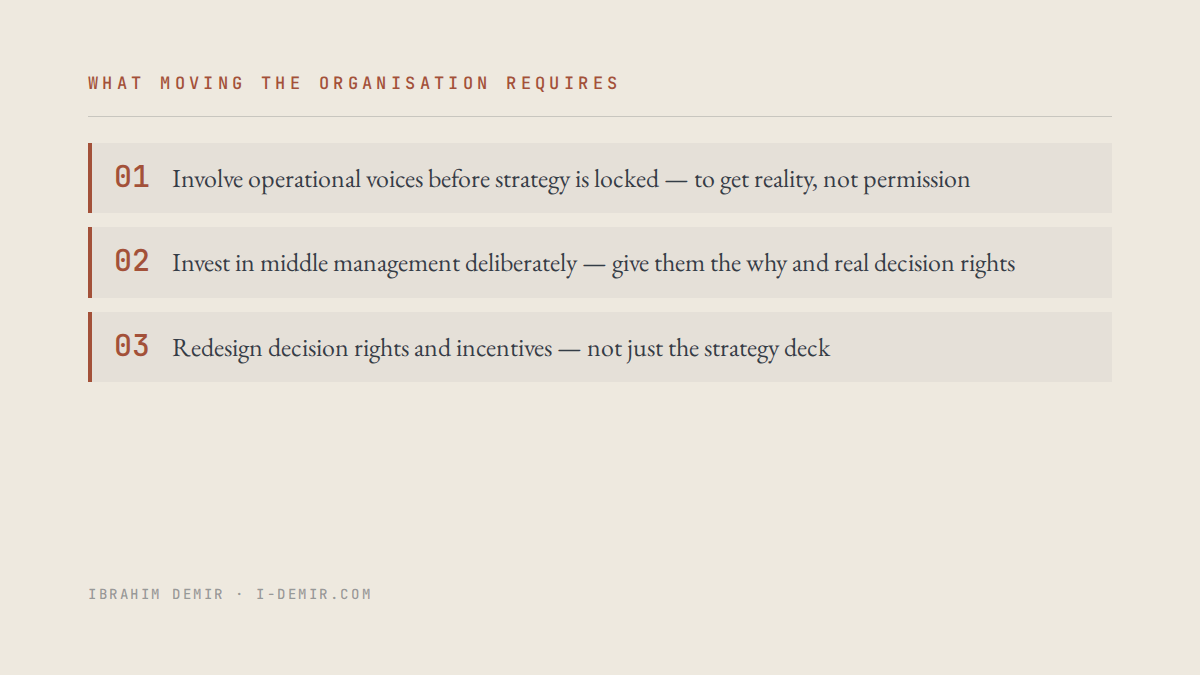
Moving the organisation requires three structural interventions that most transformation plans omit. Operational voices need to be involved before strategy is locked — not for permission, but for reality. The middle management layer needs deliberate investment in the why and real decision rights to act on it. And the decision architecture — approval layers, incentive structures, accountability mechanisms — needs to be redesigned to support the new direction rather than pull against it.
The senior leader who cannot move the organisation is not failing at strategy. They are treating the strategy as the hard problem, when the hard problem was always the present they needed to move first.
Sources:
- HBR — When Strategy and Execution Fall Out of Sync (2026)
[hbr.org/2026/01/when-strategy-and-execution-fall-out-of-sync](http://hbr.org/2026/01/when-strategy-and-execution-fall-out-of-sync)
- Balanced Scorecard Institute — The Leadership Gap: Understanding Strategy Execution Failure
[balancedscorecard.org/blog/the-leadership-gap-understanding-strategy-execution-failure](http://balancedscorecard.org/blog/the-leadership-gap-understanding-strategy-execution-failure)
- McKinsey — Unleashing the Power of the Middle Manager
[mckinsey.com/featured-insights/mckinsey-live/webinars/unleashing-the-power-of-the-middle-manager](http://mckinsey.com/featured-insights/mckinsey-live/webinars/unleashing-the-power-of-the-middle-manager)
- McKinsey — Middle Managers Can Succeed by Simplifying the Role
[mckinsey.com/capabilities/people-and-organizational-performance/our-insights/the-organization-blog/middle-managers-can-succeed-by-simplifying-the-role](http://mckinsey.com/capabilities/people-and-organizational-performance/our-insights/the-organization-blog/middle-managers-can-succeed-by-simplifying-the-role)
- HBR — The Hidden Beliefs That Hold Leaders Back (2025)
[hbr.org/2025/11/the-hidden-beliefs-that-hold-leaders-back](http://hbr.org/2025/11/the-hidden-beliefs-that-hold-leaders-back)