Why Most Transformation Programs Fail Before They Start
Most transformation programs do not fail because execution breaks down. They fail because the conditions for successful execution were never created: honest strategy, operational reality checks, real governance, portfolio fit, and a reason for change that people can actually believe in.
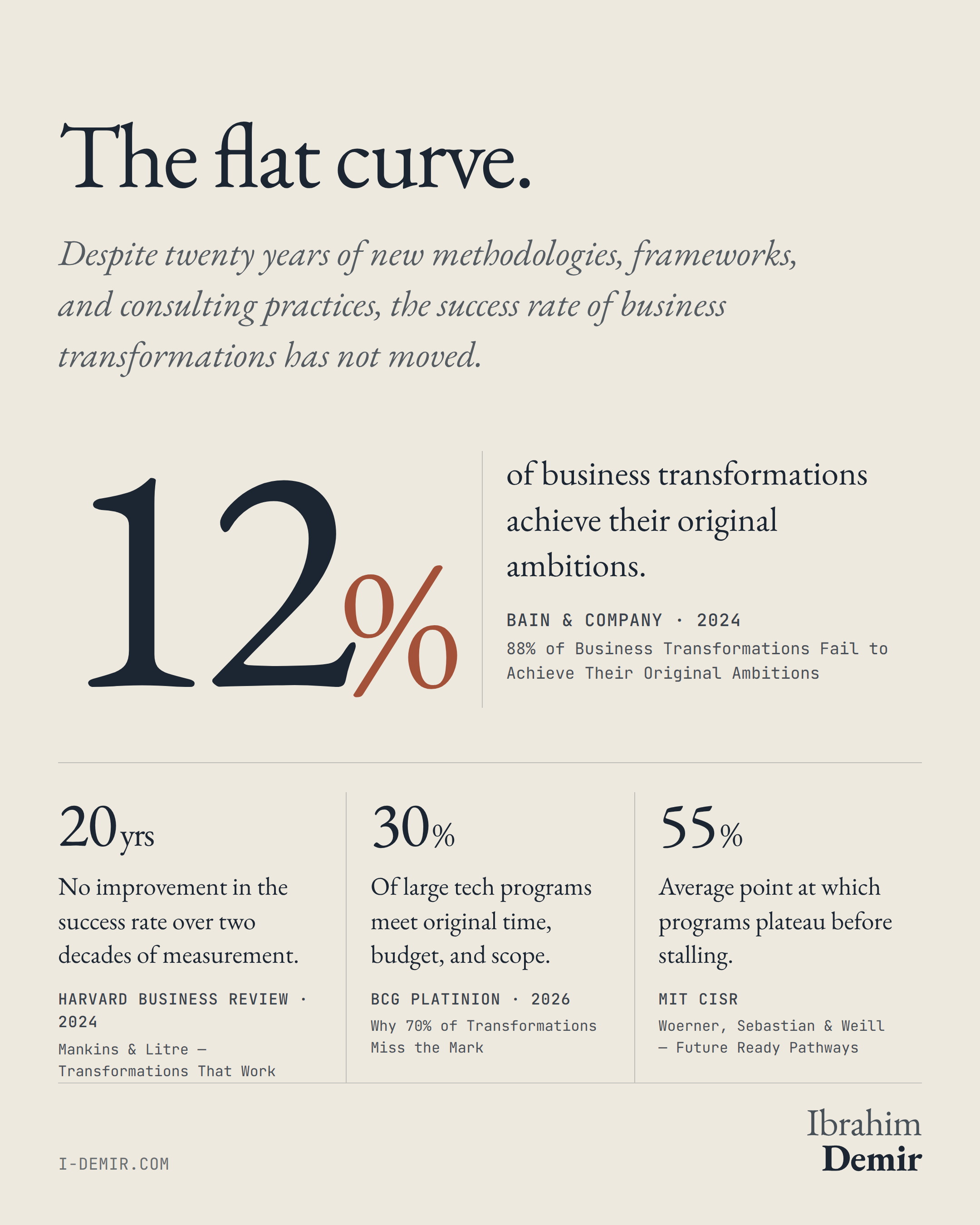
I have sat in too many rooms where a transformation was presented with a confidence that nobody in the room actually felt. The slides were polished. The business case ran clean numbers. The sponsor nodded at the right moments. And almost everyone there could feel — without saying it — that this was not going to work. That moment, the one between the polished slide and the unspoken doubt, is where most transformation programs actually fail. Not at execution. Not at the 18-month mark when budgets overrun and milestones slip. They fail before they start. Bain has put a number on it: only 12% of business transformations achieve their original ambition. Harvard Business Review, examining the same question, reports that this rate has not improved in 20 years. BCG finds that just 30% of large technology programs meet time, budget, and scope expectations. Across two decades of new methodologies, new frameworks, and new consulting practices, the curve is flat.
A stagnation that severe, despite that much investment in better execution, suggests something specific. The problem is not that we have failed to learn how to execute. The problem is that most programs are not actually failing in execution. They are failing earlier — in the way they are designed, scoped, and chartered. By the time a program is officially in trouble, the structural reasons for that trouble were almost always there on day one. Visible to the people close to the work. Invisible to the steering committee. I want to be precise about what I mean.
First, the question we usually skip
Before asking why programs fail, it is worth asking why companies attempt transformation in the first place. Most don’t transform because they want to. They transform because something — a market shift, a technology curve, a regulatory change, a competitor pulling away — has made the cost of standing still higher than the cost of changing. Or because someone senior senses it will be soon. That is the only reason that holds up under pressure. Real transformation is a response to external reality. Everything else — the rebrand of how leadership wants to be perceived, the strategy team’s quarterly need to “show movement,” the new executive’s wish to leave a fingerprint — produces what looks like transformation but operates as theater. It can occupy a calendar for two years. It rarely changes the company. The first honest test of any transformation program is this: if we did nothing, what would happen, and over what timeframe? If the team cannot give a sharp, evidence-based answer to that question, the program is already in trouble. The reason will surface later. The flaw is there now.
Present a Strategy because someone had to present something
I have watched strategy teams asked to produce a transformation strategy on a deadline they had no business accepting. When the team has nothing genuinely worked through, they present something anyway. They have to. Slides are produced. A business case is built backwards from the desired conclusion. Numbers are tuned to make the ROI clear inside the bonus horizon — usually 12 to 18 months. The longer-term damage, if anyone has thought about it, lives in a footnote nobody reads. It looks like strategy. It functions as performance. The tell is simple: ask three of the people who built the deck whether they personally believe the company should do this. If you cannot get three clean yeses, the strategy was a deliverable, not a decision. This is what the research community now calls “unclear value creation.” Multiple consulting syntheses point to it as the dominant failure mode of large programs. Ambitions are set. Budgets are committed. But the path from vision to measurable value drivers is never actually drawn. The slide says “transformation.” The math says “we filled in the cells.”
The silent-room problem
Most large transformation programs begin in confidential rooms. They are protected from the rest of the company until a certain readiness is declared. The intent is reasonable. Avoid premature speculation. Manage the message. Protect the people involved. The unintended cost is severe. The experts who actually know what would need to change — the engineers who understand why the platform groans, the project leads who know which dependencies are real and which are political, the operations people who have watched three previous attempts fail — are systematically excluded from the design. By the time the program is unveiled, it has already been shaped without the people whose informed disagreement would have made it better. The first all-hands meeting then becomes a defensive exercise: leadership protecting a design they no longer have the freedom to fundamentally change. A transformation that cannot survive expert scrutiny in its design phase will not survive expert scrutiny in execution. It will only meet that scrutiny later, more expensively, and from a defensive crouch.
Slide-deep thinking
On a slide, transformation always looks easier than it is. A box says “Migrate to Platform X.” An arrow says “Standardize processes across the four regions.” A bullet promises a 30% efficiency gain. The deck flows. The logic appears tight. Then the work begins, and the entire program starts to bend around details that were never on the slide. The four regions don’t actually run the same process; they run four mutated versions of a process nobody documented. The platform migration assumed a clean cutover; in reality there are 17 integrations nobody mapped. The 30% efficiency assumed that the people doing the work could absorb the change while still hitting their day jobs. The slide is not the strategy. The slide is the headline of the strategy. The strategy is the detail underneath, and that detail can only be properly worked through with the people who actually do the work. I have come to treat any transformation business case that lives only at deck level as unfinished. It may look ready for a board. It is not ready for execution.
The workforce-reduction shadow
Almost every transformation in a corporate context is read by employees through one filter: is this going to cost people their jobs? Even when the answer is genuinely no, the assumption arrives first. Most employees have lived through a transformation that ended in layoffs, or know someone who has, or have read enough trade press to expect it. Motivation is therefore already low before kickoff. And without the motivation of the people who actually have to carry the change, no governance structure, no incentive system, and no consultant playbook can rescue execution. People do not sabotage these programs out of malice. They simply do the minimum, protect their position, and wait for it to pass. Leadership has two choices. The first is to be honest about what is changing and who is affected, with specifics, early — even when it is uncomfortable. The second is to pretend it is fine and lose the program slowly through quiet non-cooperation. In my experience, leadership consistently picks the second and is consistently surprised by the result. The Why of a transformation has to be tied to the vision of the company in a way employees can defend in their own words. If the only Why is cost reduction, motivation will collapse. If the Why is connected to something the company is genuinely trying to become, motivation has a chance.
Programs floating outside the portfolio
A surprising number of transformation programs run as standalone exercises, with their own goals, their own metrics, and no clear line back to the company’s strategy or to its broader portfolio of work. This happens for two reasons. Sometimes there is no functioning portfolio to attach the program to. Sometimes there is a portfolio, but it is treated as administrative paperwork rather than a real instrument for prioritization. In both cases, the program ends up competing with the rest of the organization for attention, resources, and political cover, without the language to explain why it should win that competition. It becomes “the transformation program” rather than “the third lever in our three-year strategy to do X.” MIT CISR has tracked this pattern over years and observes that companies tend to make it about 55% of the way toward their stated transformation goals before stalling. The plateau is not random. It is the point at which programs that were never properly integrated into the company’s operating model run out of organizational tolerance for parallel work. Too many initiatives competing for the same scarce people, the same scarce budgets, the same scarce attention from leadership. The slowdown looks like execution fatigue. It is actually portfolio failure surfacing late. A transformation that is not visibly part of the company’s strategic portfolio will be treated as optional. It will lose to whatever is more urgent in any given week. By the end of year one, it will be quietly de-scoped.
Bonuses paid before the consequences arrive
Most transformation programs are evaluated on what happens in the first 12 to 18 months. That is the window in which the sponsoring executive will still be in the role, the bonus calculation will still apply, and the board will still be paying attention. The damage of a poorly designed transformation typically shows up in year three. The damage of a poorly designed transformation typically shows up in year three. By then, the executive who launched it has moved to another role, or another company, or has been promoted on the strength of the early results. The program’s long-term consequences are now someone else’s problem, evaluated under a different rubric, with the original logic too distant to seriously challenge. The companies I have seen do this well share one habit: they go back to old transformation programs years later and ask, with discipline, what actually happened. Not to assign blame, but to extract the lessons that nobody wanted to hear at the time. Companies that do not do this keep relearning the same expensive lesson, on a roughly 5-year cycle, with the same kind of business case. If a transformation program does not have long-term incentives, long-term tracking, and someone whose job it is to honestly assess it three years later, it is a short-term bet wearing the language of strategy.
Governance theater
Every transformation program has a governance structure. Most governance structures do not work. BCG has been blunt about this. Looking at programs that fail to deliver their business case, they find governance failures present in 63% of cases. They go further: the primary cause of failure in large programs is not technical complexity or insufficient ambition. It is “poorly structured, inappropriate governance models.” The governance was on paper. It was not in the behavior. I have seen the same pattern up close. The named sponsor is often someone senior enough to lend the program credibility, but not senior enough — or not engaged enough — to make hard kill-or-go decisions. When the program runs into resistance from the existing organizational structure, and it always does, the sponsor cannot or will not fight that battle. The program then enters a slow drift. Steering committees turn into status reviews. Risks are reported in amber forever. Decisions that should be made in three weeks take three months. By the time anyone has the authority to actually intervene, the program has lost the momentum that early conviction was supposed to give it. A real transformation sponsor needs three things. The authority to redirect resources and people. The willingness to push the program through political resistance, including resistance from peers. And the credibility to credibly threaten to stop the program if it stops being worth doing. Without all three, governance becomes ceremonial. And ceremonial governance is one of the most reliable predictors of failure I know.
False readiness
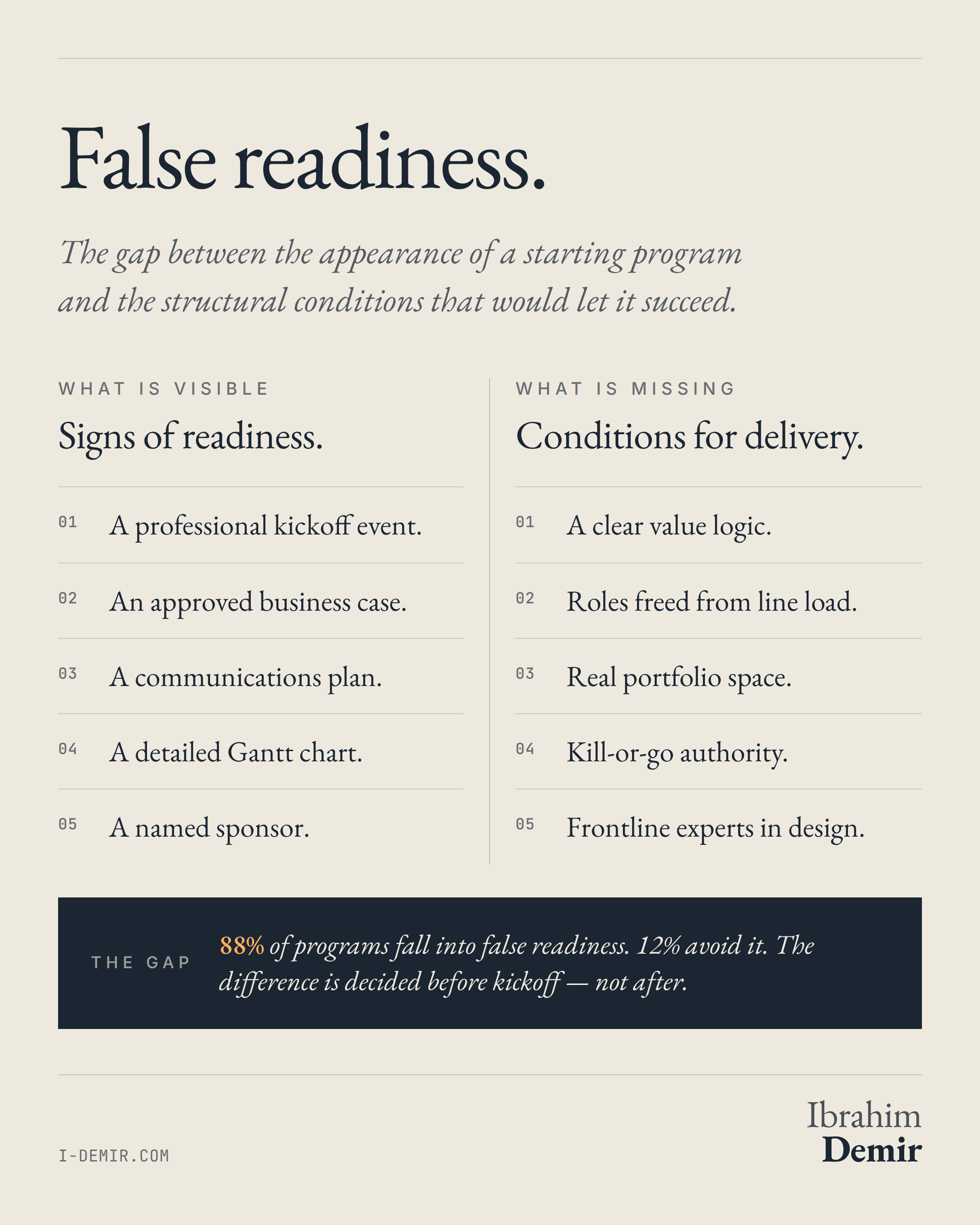
There is a useful term for what all of this produces: false readiness. A program in false readiness has the visible signs of being ready to start. The kickoff event is professionally produced. The communications plan is in place. The deck is signed off. The vendor is selected. The dates are in calendars. The Gantt chart is detailed. What it does not have is the structural conditions that would make execution actually possible. The value logic is vague. The critical roles exist on an organizational chart but the people in them are still carrying full line responsibility. The portfolio is overloaded. The governance is administrative. The narrative differs depending on which floor of the building you are standing on. You can usually tell within 4 to 8 weeks. The kickoff is impressive. The first three steering committees are not. Decisions that should be sharp come back fuzzy. The program runs on the energy of a few committed people while the rest of the organization watches to see whether this one is real. False readiness is the gap between the appearance of a starting program and the structural conditions that would let it succeed. It is what 12% of programs avoid and 88% fall into.
What this adds up to - The Charter Test
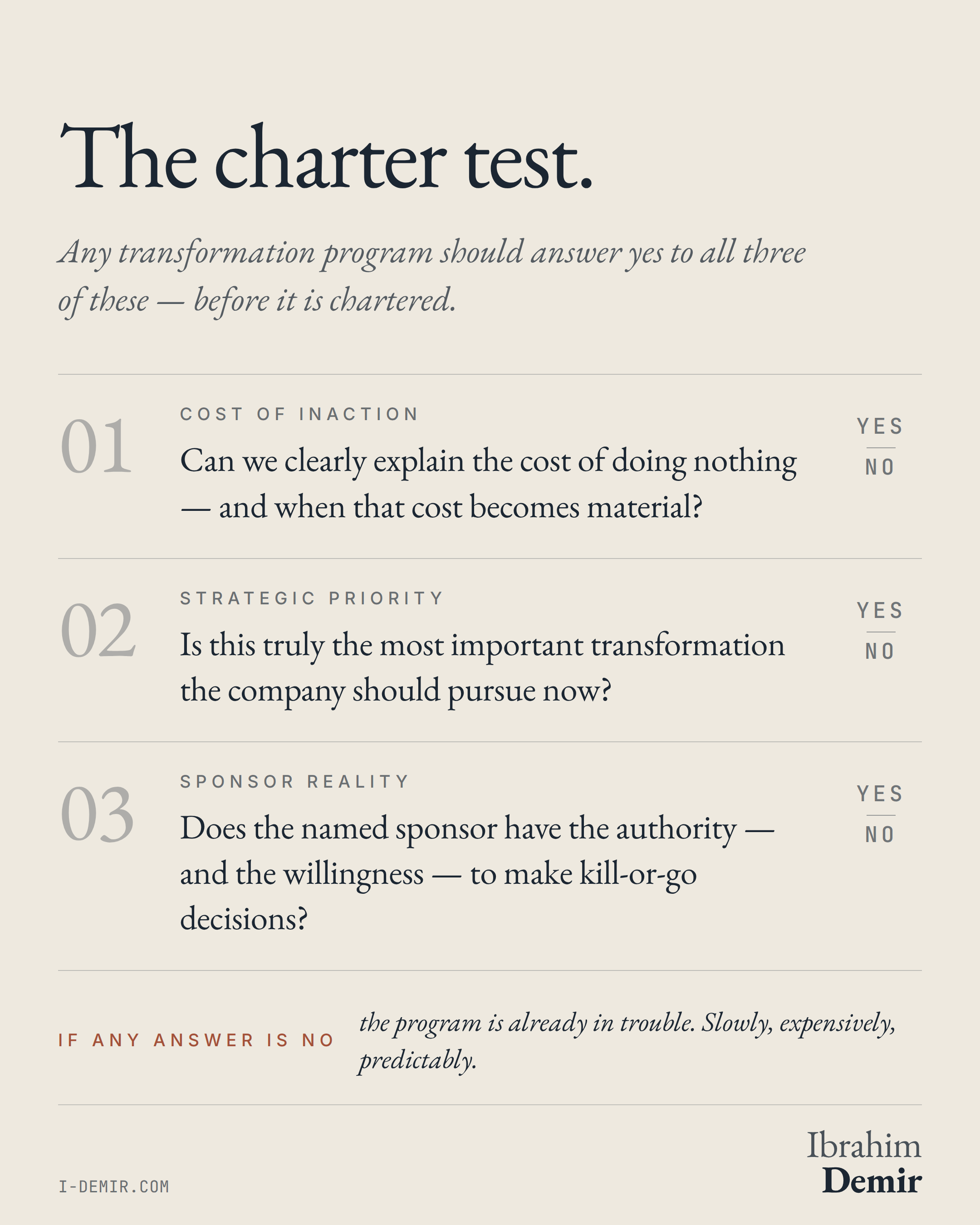
If I take all of this together, there is a kind of honesty test — the Charter Test — that any transformation program should be able to pass before it is chartered.
It is small. Three questions.
- Can we clearly explain the cost of doing nothing, and when that cost becomes material?
- Is this truly the most important transformation the company should pursue now?
- Does the sponsor have the authority and willingness to make kill-or-go decisions?
If the answer to any of these is no, the program is already in trouble. Not in the dramatic sense. In the slow, expensive, demoralizing sense that consumes two years of leadership attention and produces a polite slide deck explaining what was learned.
Most of the transformation failures I have seen were not failures of execution. They were failures of seriousness — the moment when an organization decided to act as if it were transforming, before it had decided whether it actually wanted to.
Sources
- Bain & Company (2024). *88% of business transformations fail to achieve their original ambitions.* - Harvard Business Review (2024). *Transformations That Work.* Mankins, M. & Litre, P. - BCG Platinion (2026). *Why 70% of Transformations Miss the Mark and How to Fix Them.* - McKinsey & Company. *Why do most transformations fail? A conversation with Harry Robinson.* - MIT Center for Information Systems Research. *Future Ready Pathways.* Woerner, S., Sebastian, I., & Weill, P.